
At the Surface Level
Gendered language is a part of daily conversations with others. With my position in the restaurant industry, I became frustrated with commonly misgendering young children by asking parents, “What can I get for him?” and having that awkward interaction of being corrected that their daughter would like a grilled cheese.
With some practice, I adapted the way I communicated with others by referring to all children as “kiddos.” This is one small example of how connected and complex inclusive language is within our society.
On a Deeper Level
I could share stories of how my upbringing in a 98% White1 community shaped the way I viewed others who have a different skin color than I do. Or I could share the story of how I was first confronted with my internal biases at a bystander intervention training in college, where I had to role-play the perpetrator making racist jokes in front of my peers, colleagues, and boss.
However, sharing these stories will not undo the harm that I caused to others. This does not change my past; the only step I can take forward is to change.

Moving Forward with Empathy
Empathy is defined as the action of being understanding, aware of, and sensitive to the feelings, thoughts, and experiences of others.2 I believe that this is the only rationale and ethical step forward that I can take on an individual level. With empathy, I can grow outside the bounds of self by placing myself in the shoes of another person.
Treating others how you want to be treated was how I viewed an ethical approach to equality. This comes from the eighteenth-century philosopher Immanuel Kant’s categorical imperative, as it “stresses the humanity of each person…that you should not treat people as means to an end, because, presumably, you would not want to be treated that way yourself.”3
However, when it comes to diversity, equity, and inclusion (DEI), this doesn’t acknowledge how we are all different. It ignores the challenges and preferences for different races, ethnicities, genders, and abilities. For me to think more consciously about DEI, I need to flip the script by treating people the way they want to be treated – rather than how I want to be treated.4
Where I Am Today by Identifying Misconceptions
By acknowledging how racism played a role in my past, I can see how my position and white privilege grant me power within the world I live in today. White privilege being defined as “advantages that are taken for granted by whites and cannot be similarly enjoyed by people of color in the same context.”5
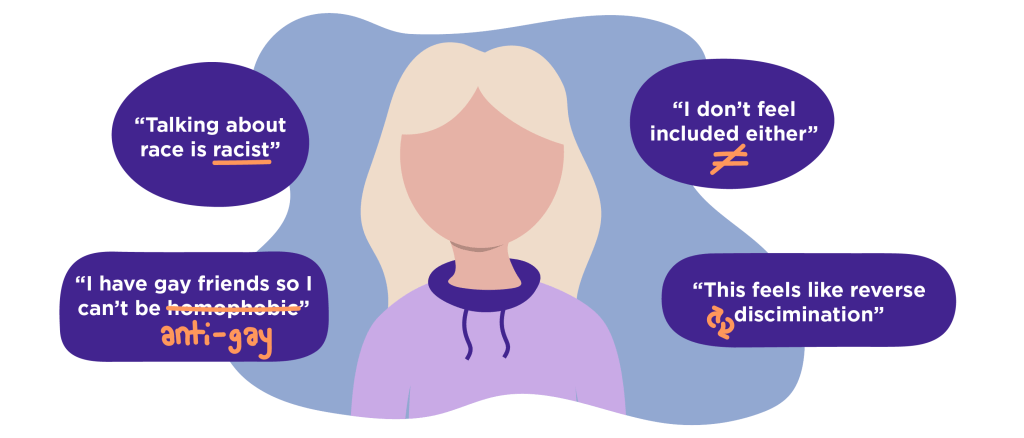
A common misconception that I have come to face is that talking about differences in terms of race may cause further harm. However, this is not the case because “simply referring to race or ethnicity is not racist.”4
Another misconception is that color blindness is the solution to racism, as it is often expressed through sentiments such as “I don’t see color” or “color doesn’t matter to me.” Color blindness promotes ideologies that if we don’t acknowledge racism, then it doesn’t exist. Statements like these lack acknowledgment of racism within our society, as “color-blind [ideologies] make it difficult to address these unconscious beliefs.”5
Where I Want to Be
“When you add your voice and your actions to situations that you think don’t involve you, you actually inspire others to do the same… To win the fight of equity we all need to speak up and stand up… We will all need to do that even when it’s hard and even when we feel out of place because it is your place…Justice counts on all of us”
– Tyler, 20196
I have come to understand that education, awareness, and diversifying the media I consume, as well as making friendships with people who are different than myself, is key for me to be able to extend my allyship to others.
By reflecting on my position and privileges in the world around me, I can see how I have a leg up against others who are different. Being educated about the hardships others face can help me stand up for them – even when they are not present. Without us – who have dominant social power – being able to stand up for them, who will?
More Blogs in the Inclusive Language Series

References
1 CBS Minnesota. 2020. ‘I Really Regret Moving Here’: How Residents Of 98% White Buffalo, Minnesota Talk About Race. June 25. Accessed April 2025. https://www.cbsnews.com/minnesota/news/you-cant-ignore-it-any-more-how-residents-of-98-white-buffalo-minnesota-talk-about-race/.
2 Merriam-Webster. n.d. Empathy. Accessed April 2025. https://www.merriam-webster.com/dictionary/empathy.
3 Neher, W. W., and P. J. Sandin. 2007. Communicating ethically: character, duties, consequences, and relationships. Pearson.
4 Yin, Karen. 2024. The Conscious Style Guide. Little, Brown Spark.
5 Diangelo, Robin. 2018. White fragility: Why it’s so hard for white people to talk about racism. Beacon Press.
6 Tyler, Dwinita Mosby. 2019. Want a more just world? Be an unlikely ally [Video]. November. Accessed January 2025. https://www.ted.com/talks/dwinita_mosby_tyler_want_a_more_just_world_be_an_unlikely_ally?autoplay=true&referrer=playlist-what_is_privilege.
 Amy Nelson Content Creations
Leave a comment