

Having conversations about DEI can be emotional and intimidating. It can be that awkward interaction of a gender-queer person correcting you about their pronouns that you just can’t seem to get right. Or it could be telling your friends to stop making jokes about Black people when you previously had laughed along. Regardless of the situation at hand, it can be difficult to know how to start the conversation or receive critique without getting defensive.
Before Starting the Conversation
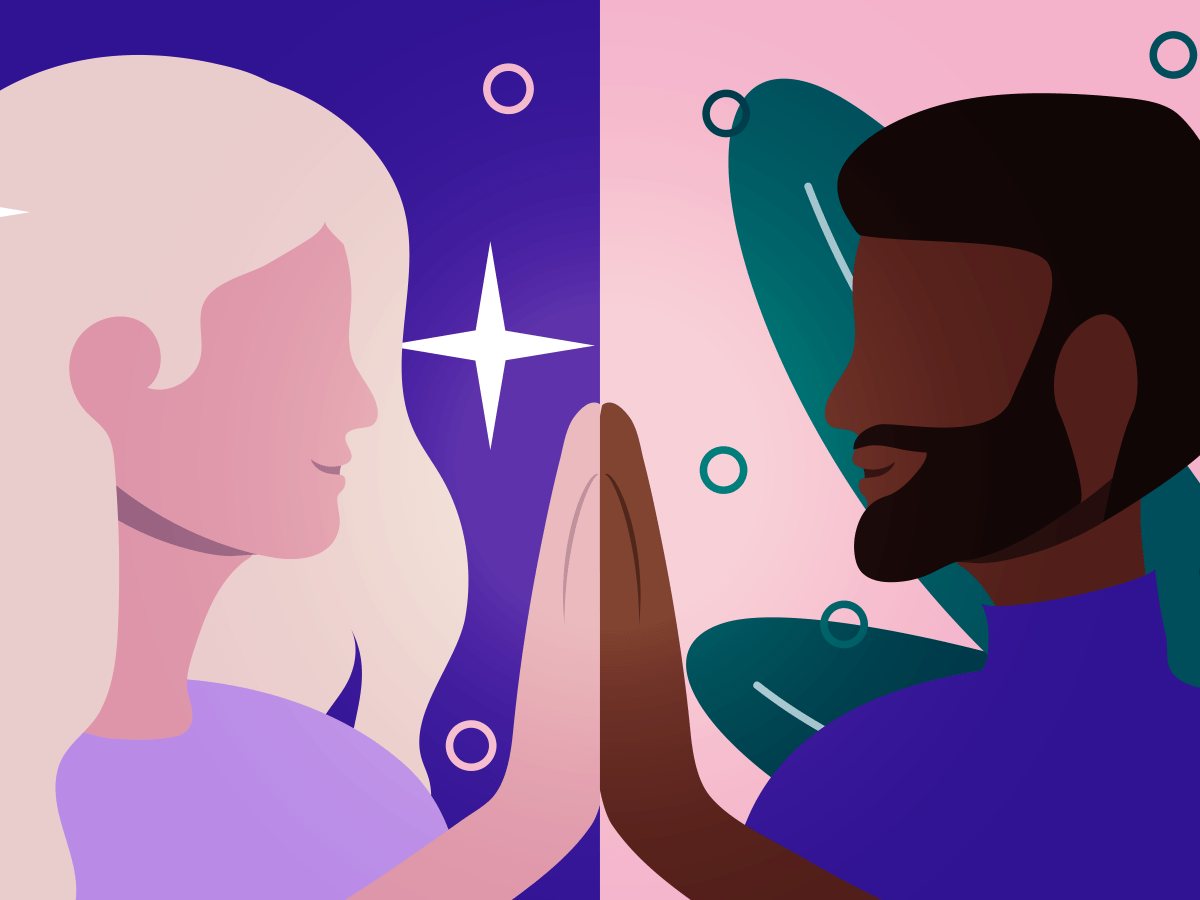
To have a productive conversation about DEI, we can use difference dialogue, where we are “able to talk freely about our differences without feeling intimidated and without being scared of offending someone or hurting someone’s feelings.”1
This allows us to award mutual respect to all involved in the conversation. Our differences help us “see, hear, and value perspectives of others, even those with whom you may not agree.”2 Both sides may have different perspectives, feelings, and preferences – which is okay.
Dialogical theorist Martin Buber explains this type of dialogue by defining two relationships in which we communicate, I-It and I-Thou. The first, I-It relationships are those where we focus on personal thoughts and opinions rather than listening to the other.3 The second, I-Thou relationships are those where we fully immerse ourselves within the conversation by actively listening to the other.3 By taking an I-Thou approach to DEI conversations, we can award mutual respect and practice empathy.
Sometimes, it can be a reflex to react out of emotion. When emotions are high, it can be difficult to have a constructive conversation. Setting aside time to talk allows both the speaker and listener to be mentally and emotionally available to have a conversation.
We can do this by setting an appointment to have a safe conversation.2 We can ask “Is this a good time to talk about [topic in question]?” or “Can we talk about [topic in question] later? This is important to me.”
Tips for Safe Conversations
Authors Hendrix and LaKelly Hunt (2024)2 developed a safe conversation framework to help us engage in difference dialogue. It is important to note that both sides deserve mutual respect and validation.
Safe conversations dialogue consists of the following:
Mirroring is the technique of simply repeating what the other has said.2 This helps improve our active listening skills and allows the other person to expand on their viewpoint.
Validating allows the listener to see the others’ viewpoint without implementing their own views by engaging in I-Thou conversations.2
Empathizing allows the listener to share their experiences and imagine how the speaker is experiencing the world from their viewpoint.2 This helps us to walk in the shoes of the other person.
Empathy With Everyone
When we practice empathy, we open ourselves up to seeing how we are all different. As I have said before, differences are okay because that’s what makes us unique. Being vulnerable with each other allows us to connect and grow.
Zero Negativity & Pushback
Negativity in DEI conversations commonly sounds like pushback. There are three types of pushback claims: denial, disengagement, and derailment.4
These types of claims sound like, “I have gay friends, so I can’t be anti-gay” (denial), “I didn’t want to say the wrong thing, so I didn’t respond” (disengagement), or “This feels like reverse discrimination” (derailment).
Pushback can stem from threats to individual identity or social identity – or both.4 The threat to individual identity comes from an individualist ideology that “there are no intrinsic barriers to individual success…[and] race is irrelevant,”5 or, I have heard recently described as a merit-based ideology. The threat to social identity supports social groups that have power.
An example of this is White supremacy, defined as “a sociopolitical economic system of domination based on racial categories that benefits those defined and perceived as white.”5 When our social power is threatened – our White fragility is broken, which can result in a “form of bullying…that keeps people of color in line and ‘in their place’…[as it is] an outcome of white people’s socialization [to maintain] white supremacy.”5
“There is a pushback on these developments as well. When it comes to the rights of minorities, have we come too far? It’s a notion that seems to be growing these days that when it comes to the rights of minorities things have been taken too far to an extreme… Pushing this sort of narrative is a revival of political traditionalism and nationalism, one where the majority identity is supreme.”
–Saeed, 20196
I have heard claims that we have come too far with inclusivity and that others are becoming too sensitive. When we bring offensive language and harmful actions to the awareness of our peers, colleagues, or friends, it is important to practice zero negativity.
With zero negativity, it is important to use first-person language and I-statements.2 We can turn our frustrations with negativity into a wish for change – that is specific and positive.
An example of when you wish someone would adopt more inclusive language is:
“I get frustrated when you say the r-word in conversations because it is offensive to the disabled community. I wish you would use another word instead, such as ignorant, reckless, or another term that is more specific for what you mean.”
An example of when you are receiving feedback is:
“I get frustrated and embarrassed when I get called out on making jokes in front of others. Can you please explain it to me in private so I have the understanding to change?”
Affirmations
This is the final step in the framework that helps maintain compassion and restore positivity in relationships. Affirmations can be viewed as “unconditional value and appreciation”2 towards others. When we affirm others, we “shift from wanting to giving, from complaining to gratitude, from emptiness to fullness, from the past to the future.”2
We can express this by expressing gratitude for the time and vulnerability to the other. We can “show patience, kindness, confidence, humility, curiosity; you listen without judgment and talk without criticizing.”2
This framework allows us to have structure to our conversations because when that happens, “safety happens; when safety happens, connecting happens. And connecting ignites a collaborative process that can transform the negative energy of conflict into the vibrant energy of feeling fulfilled, fully engaged in life, and joyful.”2
More Blogs in the Inclusive Language Series

References
1 Stovall, Janet M, and Kim Clark. 2022. The Fine Art of Not Saying Stupid Sh*t. Vol. 1. Publish Your Purpose.
2 Hendrix, Harville, and Helen LaKelly Hunt. 2024. How to Talk to Anyone about Anything. Thomas Nelson.
3 Neher, W. W., and P. J. Sandin. 2007. Communicating ethically: character, duties, consequences, and relationships. Pearson.
4 Rai, Trisha, and Caitlin Dutkiewicz. 2022. How to Navigate Pushback to Diversity, Equity and Inclusion Efforts. May 10. Accessed March 2025. https://www.gartner.com/en/articles/how-to-navigate-pushback-to-diversity-equity-and-inclusion-efforts.
5 Diangelo, Robin. 2018. White fragility: Why it’s so hard for white people to talk about racism. Beacon Press.
6 Saeed, Fahad. 2019. The importance of using inclusive language. November. Accessed April 2025. https://www.ted.com/talks/fahad_saeed_the_importance_of_using_inclusive_language.
 Amy Nelson Content Creations
Leave a comment