
Disclaimer
This article contains offensive language. The intent is to educate about inclusivity, which requires analyzing why specific terminology is not accepted.
I do not claim to have all the answers for inclusive language, nor can I speak on behalf of social groups I am not a part of. If I have misspoken or if you have more knowledge on the topics covered within this article, please leave your feedback in the comment section below.
The goal of inclusive language consider all the ways in which we are different by respecting everyone’s preferences when communicating with each other.
I am not going to tell you what you should or should not say because “the do/don’t system is not rooted in reality, because no group has one take.”1 Additionally, inclusive language is not politically correct, as that is more about “using terms intended to avoid offense…[and] treats words as a ‘one size fits all’ [solution]”1 Language requires adaptability because “it is more important to be flexible than consistent.”1
Within this guide, I will provide options for you and me to consider for becoming a conscious communicator. I am limiting the scope of this guide to focus on race and ethnicity, gender and sexuality, and disability. This is not an all-encompassing, but it is a starting point for holding myself accountable.
Table of Contents
- Table of Contents
- Helpful Tips for Getting Started
- Key Term Dictionary
- Grammar
- Race & Ethnicity
- Gender & Sexuality
- Disability & Accessibility
- Always Avoid
- References

Helpful Tips for Getting Started
As you become more conscious of how you communicate, you may subsequently become more aware of instances of inclusive language. Keep a log, save documents, or take notes because “with some practice, noticing everyday conscious language around you can become second nature.”1
I often question whether I should mention someone’s identity – or how much – when retelling stories in casual conversation to friends and family. As a rule of thumb, the details of someone’s identity are only relevant when they are central to the story.1
When adopting inclusivity into the way we write, speak, and communicate, know that this will take time. To this day, after habitually and consciously practicing using they/them pronouns when gender identity is unknown – I still mess up. I recently referred to a mascot in a parade as “it” and quickly said, “sorry, they.”
Give yourself grace to make mistakes, and remember to be quick to acknowledge the mistake, express condolences, and make the correction.
Key Term Dictionary
Before diving straight into the wormhole of inclusive language, it is important to have a strong understanding of these key terms.
Race & Ethnicity
Race is a biological construct that seeks to draw divisions in society, often based on physical attributes such as the color of our skin, i.e. Black vs. White. However, race, like gender, is socially constructed.2
Ethnicity is “a social construct that divides people into smaller groups based on characteristics such as shared sense of group membership, values, behavioral patterns, language, political and economic interests, history, and ancestral geographical base.”3 Ethnicity is commonly identified through heritage or nationality such as Asian, Italian, or French.
Racism, not to be confused with discrimination, involves one group having the power to carry out systemic discrimination through institutional policies and practices.3
Xenophobia* is any attitude, behavior, practice, or policy that reflects the belief that immigrants are inferior to the dominant group of people.3 In other words, xenophobia is a strong dislike towards others and the belief that the dominant group, which in our case is usually White people, is the superior group.
Discrimination is “action based on prejudice…including ignoring, exclusion, threats, ridicule, slander, and violence.”2
Gender & Sexuality
Gender is a social construct of norms, behaviors and roles4 and is often referred to as man, woman, or nonbinary. Gender and sex are used interchangeably within today’s society, but there are differences.
Sex is the biological anatomy of the reproductive organs that is typically assigned at birth4 and is often referred to as male, female, or intersex.
Intersex is used when people don’t fit typical definitions of male or female4 based on their reproductive anatomy.
Nonbinary is a term used for those who do not fit into the typical man or woman genders, or into both.
Trans, or transgender, is an adjective used to describe someone whose gender identity differs from the sex assigned at birth.4 Trans people often go through a gender transition to align their physical bodies with the gender they identify with.
Sexuality, or sexual orientation, is the physical, romantic and/or emotional attraction to members of the same and/or other genders.4
Gay usually refers to men who are attracted to men.5
Lesbian usually refers to women who are attracted to women.5
Bisexual, or bi, refers to someone who is attracted to two or more genders,5 and is usually referred to as being attracted to both men and women.
Pansexual, or pan, is someone who is attracted to people of any or all genders.5
Homophobia*, or anti-gay or anti-LGBTQIA+, is a strong dislike or hatred towards same-sex couples.
Transphobia*, or anti-trans, is a strong dislike or hatred towards trans people.
Disability & Ability
Disability, or disabled, generally describes functional limitations that affect one or more of the major life activities.6
Ableist, or ableism, is a type of discrimination towards people with disabilities as it comes in all forms, from overt prejudice to more subtle microaggressions.6
Deaf, or hard of hearing, describes people with profound or complete hearing loss…many people do not consider being deaf as a disability. Instead, deafness is often considered a culture.6
Blind is the acceptable term for people with complete or almost complete vision loss; low vision or limited vision is often accepted for those who are not completely blind.6 In contrast, visually impaired is not widely accepted because impaired implies that they cannot function in life.
*-Phobias will be addressed later within the disability section
Grammar
Capitalization
In 2020, The New York Times and The Associated Press Stylebook decided to capitalize Black when referring to race as the same rules apply when talking about Hispanics, Natives, and Asians.1 This can also be applied when referring to White people too.
Context matters regarding the capitalization of words. For a general rule, always capitalize when referring to people – Indigenous people or Black people – and use lowercase for generic uses or as adjectives – indigenous plants or black hair.
Acronyms & Alphabet Soup
Acronyms can be considered overinclusive because they use broader-than-necessary terms as a strategy when we want to use fewer words or cover our bases.1 Sometimes we may want to consider being specific instead.
LGBTQIA+ has become the all-encompassing term when referring to the queer community. However, there may be instances when you are simply referring to sexuality and not gender identities.
AAPI, Asian American and Pacific Islander, is a broad term that covers many countries and regions.
BIPOC, Black and Indigenous People of Color, is another acronym that includes an array of people.
While it may be out of habit to include all, there may be times when it is okay to exclude and be specific about whom you are talking to.1
Accents
Always include accents on names. It is easy to blame technology when “accent marls, tildes, and other diacritics are dropped from people’s names.”1 However, this is a weak excuse as it can be considered disrespectful even when it is unintentional.
Race & Ethnicity
Black & African American
The roots of American history falls on the backs of enslaved African Americans. From the very beginning, they had no rights as it was written into the U.S. Constitution that each Black person would count as three-fifths of a person.7 Recently, with the death of George Floyd in 2020, many of us White folks are waking up to the racial injustices that exist today – myself included.
Inclusive Language Considerations
In the 1960s, Negro was a widely accepted term to describe those who are Black or African American. Today, Negro or the n-word, is a racial slur.8
The n-word commonly appears in rap and pop songs sung by Black artists. It is important to note that due to the historical ties of the n-word to the Black community, it is a term that they can use – but we, White people, should not. Singing along to the n-word in a song is no different than saying it all together. This is an example of how complexity and reclamation comes into play.
African American is still accepted as a term to describe ethnicity, for some.8 However, not all Black people consider themselves African American. This is due to the slave trade that resulted in many severed family trees.
Black, with a capital B, is a more widely accepted term to describe race. This can also be used to describe this social group as a whole and to refer to Black culture.8
The Black Lives Matter9 movement acknowledges the challenges that Black people face by fighting for injustices around the world. During the racial awakening that followed the death of George Floyd, it was common to see people question this by asking, don’t All Lives Matter? While yes – in theory, they do; but that erases the urgency for change and derails the purpose.
People of Color, or POC, is an all-encompassing term for Black and brown people, which includes biracial identities.* However, this term is commonly used when solely talking about Black people. The problem is that when we say ‘POC’ when we actually mean ‘Black people’ concedes that there’s a need to describe a marginalized group as ‘less’ Black for people to have empathy for an issue.10
*Biracial is the preferred term when describing two races over mixed.8 As always, it is best to ask people how they identify.
Latino & Hispanic
Today, the Latino community is the largest ethnic minority in the U.S.11 Latino culture greatly influences food, sports, art, and entertainment in America. There are many intersectionalities within this social group as there is an array of ethnicities, races, religions, and languages.12
Alongside the civil rights movements of the 1960s fighting for desegregation, commonly associated with Black history, there was another Chicano Civil Rights Movement for Latinos and Latinas in the U.S.13 During this movement, they fought for desegregation in schools and better living and working conditions. They continue to advocate today for issues on immigration, education, healthcare, housing, and voting rights.13
Inclusive Language Considerations
Latino, Latina, and Hispanic are often used interchangeably to describe people from Spanish speaking countries; however, Hispanic is the most accurate term in this context.14
Spanish is the national language in over 20 countries,15 has the second highest number of native language speakers in the world, and is ranked fourth overall for the total number of speakers globally.16 In other words, that’s a lot of people, and not all who identify as Latino or Latina in the US can speak Spanish.17
Latino or Latina, (-o for male and -a for female), are used to describe people from Latin America or ancestry.14 Mexican, Puerto Rican, and Colombian are all ethnicities from Latin America.
Latinx emerged “as a gender-neutral alternative to Latino and Latina.”1
Latine has gained popularity in place of Latinx as it is more closely related to the Spanish language of adding an -e for gender-neutral terms.1
Immigrant and Migrant are used to describe people who have moved from one country to another. These terms may carry bias, especially in the political climate. The terms illegals, illegal immigrants, or illegal aliens can imply that they have committed crimes to help to carry out political agendas. Undocumented can be used as an alternative in place of illegal, as it helps to humanize them.14
This is a reminder to always ask which term people prefer.
Indigenous and Native
The US has a long and mostly ugly past with the mistreatment of Indigenous people. In early elementary, I was taught that Christopher Columbus led the colonization of North America and the origins of Thanksgiving – from a white perspective.
Recently, Columbus Day has changed to Indigenous Peoples’ Day in an effort for the recognition of the devastation that Columbus wreaked on Native communities.18 There have been numerous movements, such as the Lands Back Movement19 that advocates for Indigenous rights.
From textbooks to pop culture, Thanksgiving is usually portrayed as pilgrims and Indians happily sharing food and giving thanks to one another for coexisting. However, the English pilgrims continued to attack and take over Native American lands despite their agreements.18
I’ve even witnessed a switch within sports by renaming teams to be more inclusive. An example is the renaming of the Esko Eskomos, the team name for Ekso Public Schools in Minnesota, which was a result of legislation that prohibits using Native American mascots, nicknames, and logos within MN schools.20
Eskimo is considered a derogatory term.21 This originates from Icelandic-Canadian settlers who were “widely rumored among Winnipeggers to be from a ‘blubber-eating race’ and of ‘Eskimo’ extraction.”22
Inclusive Language Considerations
Native is often used to describe Indigenous people from various regions and is also used as an adjective. Terminology can vary widely depending upon region, tribe, and nation, so it is best to ask the person or group which term they prefer.23
Below is a list of how terminology varies by region for consideration.23
| Region | Accepted Terms |
|---|---|
| United States* | American Indian, Indian, Native American, Indigenous or Native |
| Artic | Inuit, Yup’ik, Aleut |
| Canada | First Nations, First Peoples, or Aboriginal |
| Mexico, Central America, and South America | Indígena (Indigenous), comunidad (community) or pueblo (people). |
*In the US, note that the term Native American has been falling out of favor with some groups18 as other terms are preferred over this. It is best to always ask what term the person or tribe would like to be called.
Gender & Sexuality
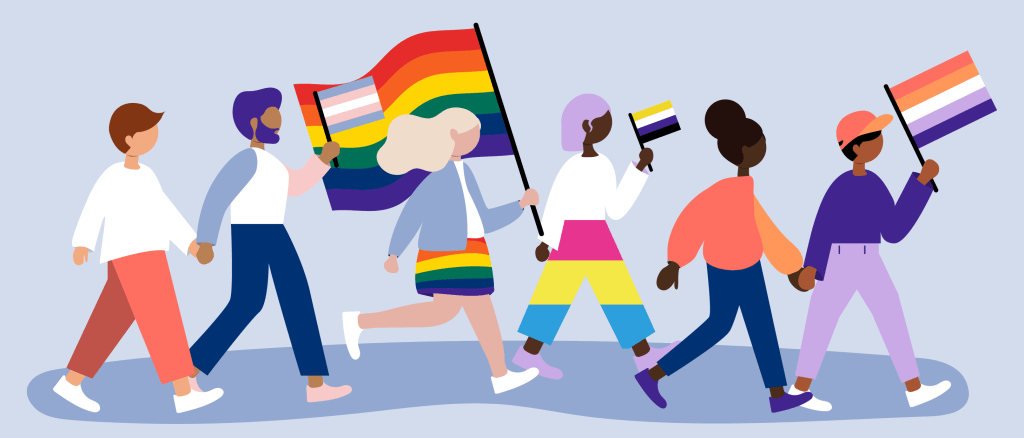
Let’s never forget that Pride started as a riot. There is a long history of discrimination and fetishization among the queer community. We have come a long way in the past ten years since same-sex marriage was legalized in 2015.24 As a result of this, society has become more accepting of those of different sexualities. I have seen more on-screen time of LGBTQIA+ people and characters being featured in movies and TV shows.
More specifically, and out of mere observation, it appears that the cis-gendered White gay man is more palatable and widely accepted than all other sexualities, gender identities, and intersectionalities. Further, LGB people are more accepted than their trans, non-binary, and gender-diverse counterparts.
To this day, trans rights have become a political weapon. Trans people have faced a long history of fetishization and obsession with their anatomy. In movies and TV shows, the Family Guy episode with Brian and trans character Ida Davis as an example, trans people have been portrayed as being so vile that it causes people to throw up. There is still a long road ahead for LGBTQIA+ rights, queer acceptance, and equal representation.
Tips for LGBTQIA Inclusivity
- Do not “out” closeted people on their sexuality or gender identity – this is especially important for LGBTQIA+ youth.
- Do not make assumptions about someone’s sexual identity.
- If you don’t know what pronouns to use, listen first.
- Do not ask what bathroom trans or gender-diverse people use.
- Do not ask trans people about medical operations or genitals.
- Do not deadname someone.
- Avoid backhanded compliments such as “You look like a real woman” or “I would have never thought you were a man.”
- Be patient with people who are questioning.
Gender Coded Language
Gender is deeply ingrained within language. In English, many “male-gendered terms…are intended as neutral”1 such as fishermen, mailmen, and salesmen. Yet those who do not identify as man, or another gender identity, may feel excluded.
Below is a list for some gender-coded language considerations. Some of these are terms I have jotted down from consciously listening to others.
| Term or Phrase | Consider Using |
|---|---|
| Fisherman or Fisherwoman | Fishers |
| Salesman or Saleswoman | Business Owner or Entrepreneur |
| Mailman or Mailwoman | Postal Worker |
| Waiter or Waitress | Server |
| Actor or Actress | Entertainer |
| Fireman or Firewoman | Firefighter |
| Happy Life, Happy Wife | Happy House, Happy Spouse |
| Boyfriend or Girlfriend | Partner |
| Breast Feeding | Chest Feeding |
| Women’s Wellness Exam *Specific for healthcare uses | Cervical Screenings or Reproductive Health Exams |
Adopting They/Them Pronouns
They/them can be used as both a plural or singular pronoun. They/them pronouns are usually used by someone who is nonbinary, gender fluid, or androgynous. Along with different gender identities, someone may be cisgender (man or woman) but have a different gender expression, known as femme or masc presenting. This can often lead to misgendering by improper pronoun usage.
My favorite way to explain they/them pronouns is to think of a dog you pass by on the street. When you engage and ask the owner if you can pet their dog, it feels wrong to refer to the dog as an it. As dogs, cats, and pets can look identical between sexes, it is easy to misgender animals.
Instead of asking “can I pet it?” you can ask “can I pet them?” and wait for the owner to gender the animal or continue to use they/them pronouns by stating “they’re so cute!” The same applies to people. It is dehumanizing to address or refer to someone as an it, heshe, shemale, etc. Start with they/them until you know.
Disability & Accessibility
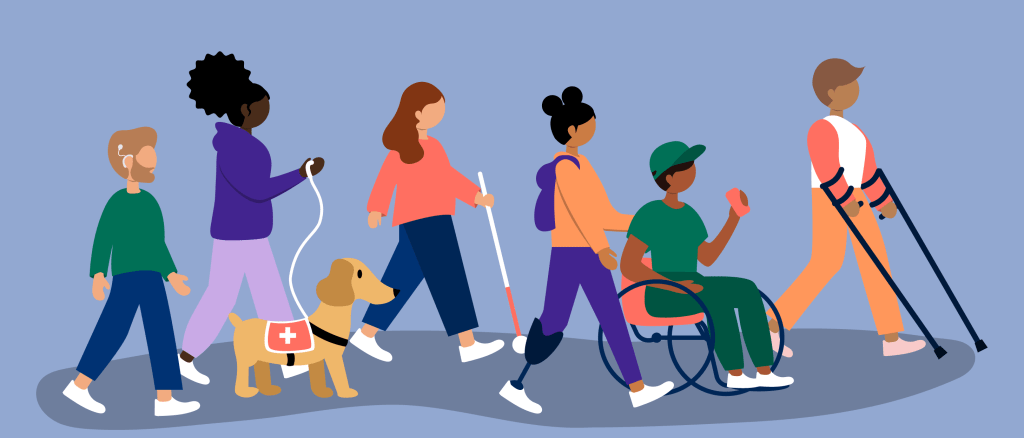
There is a wide range of mental and physical disabilities that fall within this category for inclusive language. Similar to other categories, it is always important to ask the person how they would like to be identified because “people take different approaches when communities disagree on which identifier is more appropriate, such as identity-first language (disabled person) or person-first language (person with a disability).”1 In general, there has been a shift towards acknowledging disabled people as people – not their disability.
Here is a list of some terms for consideration:25
| Term or Phrase | Consider |
|---|---|
| Able-bodied | Non-disabled or enabled |
| Derp, Duh, Doy *Meant as an onomatopoeia to mock the sounds of disabled people | Obviously, of course, hell yeah, fuck yes |
| Differently Abled or Special Needs | Disabled Person or Person with a Disability |
| Hermaphrodite | Intersex |
| Midget | Little People, Small Stature |
| Retard or [Anything]-tard | Uninformed, Reckless, Ignorant |
| Delusional | Out of Touch, Disconnected |
| Narcissistic | Selfish |
| Spaz or Spastic | Someone with Cerebral Palsy |
| Deformed or Deformity | Use the specific condition, i.e. amputee |
| [Something]-Phobic *Phobias indicate a fear of something | Anti-[Something], Hate of, Prejudice Against, Oppressive |
| Handicapped | Use the specific condition or use person with a disability |
| Insane Asylum | Behavioral Health Hospital or Psychiatric Hospital |
Special Grammar Considerations
In contrast to the section earlier regarding grammar of capitalization, different disabled communities have varying preferences. For example, “some autistic people use capital-A Autistic.”1 As Autism is a spectrum, some may prefer the term neurotypical or neurodivergent instead or interchangeably.
Another exception is that “some deaf people [prefer] capital-D Deaf when referring to Deaf culture and lowercase-d to describe the condition of deafness.”1
Accessibility Considerations for People Who Are Deaf or Blind
Accessibility is another form of being a conscious communicator, especially when it comes to technology. Simple steps such as including captions on videos and adding metadata descriptions to images on websites play an impactful role when engaging with these communities.
Another consideration when thinking of accessibility is color blindness. Adobe Color26 recently added contrast and color-blind checkers, which allow designers to double-check their work before publishing.
Disability Metaphors & Phrases
I am guilty of referring to my lack of focus as being ADHD or the need to deep clean my apartment as OCD, when I have neither condition. This can be offensive because it is making a joke of an oppressed group.1
Below is a list of alternatives for consideration for metaphors and phrases such as “I am feeling [insert term].”1
| Term or Phrase | Consider |
|---|---|
| OCD | Meticulous, Clean |
| ADHD | Distracted |
| PTSD | Triggered, Distressed |
Always Avoid
Ignorance is bliss until you make a clueless comment or joke at someone else’s expense. Knowledge is power, and once you learn that a term is offensive – do not use it or sing along to it.
Below is a list of other things to consider avoiding overall as it is harmful and offensive:1
- Do not compare humans to animals.
- Do not make a joke poking fun at a marginalized group.
- Do not mock people based on appearance, speech, pronunciation, or other irrelevant characteristics of people you do not like.
- Do not use marginalized groups as clickbait.
- Avoid violent metaphors.
Inclusive language “acknowledges diversity, conveys respect to all people, is sensitive to differences and promotes equal opportunities.”21 Adopting inclusive language allows us to show mutual respect to others by considering preferences. As always, it is important to ask how people want to be addressed, as no social group has a single take on how they prefer to be addressed.
Becoming educated about inclusive languages and other cultures allows us to become more conscious of the way we communicate by confronting biases. When we shift the way we speak, we become more inclusive and take one step closer to allyship. At the end of the day, we all want to be accepted and equally respected without judgment – and inclusive language helps us accomplish that.
More Blogs in the Inclusive Language Series
References
1 Yin, Karen. 2024. The Conscious Style Guide. Little, Brown Spark.
2 Diangelo, Robin. 2018. White fragility: Why it’s so hard for white people to talk about racism. Beacon Press.
3 Racial Equity Tools. n.d. Racial Equity Tools Glossary. Accessed April 2025. https://www.racialequitytools.org/glossary.
4 Wamsley, Laurel. 2021. A Guide To Gender Identity Terms. June 2. Accessed April 2025. https://www.npr.org/2021/06/02/996319297/gender-identity-pronouns-expression-guide-lgbtq.
5 It Gets Better Project. n.d. Glossary. Accessed April 2025. https://itgetsbetter.org/glossary/?gad_source=1&gclid=CjwKCAjwzMi_BhACEiwAX4YZUNNu5JCfbNl-O5TBCeFgw5Csa60J82j8qkTYjewlslrXn5CPpxoA1hoC_OMQAvD_BwE.
6 National Center on Disability and Journalism. 2021. Disability Language Style Guide. August. Accessed April 2025. https://ncdj.org/style-guide/.
7 Pruitt, Sarah. n.d. The History of the Electoral College Debate. Accessed April 2025. https://www.history.com/articles/the-history-of-the-electoral-college-debate.
8 NABJ. 2025. NABJ Style Guide. February. Accessed April 2025. https://nabjonline.org/news-media-center/styleguide/#styleguide-overview.
9 Black Lives Matter. n.d. About. Accessed April 2025. https://blacklivesmatter.com/about/.
10 Adams, Joshua. 2018. Why We Need to Stop Saying ‘People of Color’ When We Mean ‘Black People’. October 17. Accessed April 2025. https://level.medium.com/we-should-stop-saying-people-of-color-when-we-mean-black-people-29c2b18e6267.
11 National Museum of the American Latino. n.d. (b). Latinos & Latinas in the US. Accessed April 2025. https://latino.si.edu/learn/latino-history-and-culture/latino-history/latinos-latinas-us.
12 n.d. Somos. Directed by Alberto Ferreras. Produced by National Museum of the American Latino.
13 National Museum of the American Latino. n.d. (a). Latino Civil Rights. Accessed April 2025. https://latino.si.edu/learn/latino-history-and-culture/latino-history/latino-civil-rights.
14 National Association of Hispanic Journalists. 2021. “Cultural Competence Handbook.” NAHJ. March. Accessed April 2025. https://nahj.org/wp-content/uploads/2020/08/NAHJ-Cultural-Competence-Handbook.pdf.
15 Lingoda. n.d. What are the Main Spanish Speaking Countries? Accessed April 2025. https://www.lingoda.com/en/content/spanish-speaking-countries/.
16 Ethnologue. 2025. What is the most spoken language? Accessed April 2025. https://www.ethnologue.com/insights/most-spoken-language/.
17 Mora, Lauren, and Mark Hugo Lopez. 2023. Latinos’ Views of and Experiences With the Spanish Language. September 23. Accessed April 2025. https://www.pewresearch.org/race-and-ethnicity/2023/09/20/latinos-views-of-and-experiences-with-the-spanish-language/.
18 Native Knowledge 360. n.d. (a). Teaching & Learning about Native Americans. Accessed April 2025. https://americanindian.si.edu/nk360/faq/did-you-know#category-1.
19 Cultural Survival. 2020. Get Involved in the #LandBack Movement. October 12. Accessed April 2025. https://www.culturalsurvival.org/news/get-involved-landback-movement?gad_source=1&gclid=CjwKCAjw8IfABhBXEiwAxRHlsL7stBRTPjWgmjyHgEPbXjr27nwNGrmfV2W2cfaJ7ZPBto37GnhTVhoCBKkQAvD_BwE.
20 Riley, Hunter. 2023. Eskomos no more: Esko school board to abandon name. June 13. Accessed April 2025. https://www.wdio.com/front-page/top-stories/eskomos-no-more-esko-school-board-to-abandon-name/.
21 Stovall, Janet M, and Kim Clark. 2022. The Fine Art of Not Saying Stupid Sh*t. Vol. 1. Publish Your Purpose.
22 Bertram, Laurie K. 2021. “”Eskimo” Immigrants and Colonial Soldiers: Icelandic Immigrants and the North-West Resistance, 1885.” Canadian Historical Review 102 (s1): s309-s338 https://doi-org.wsuproxy.mnpals.net/10.3138/chr-102-s1-022.
23 Native Knowledge 360. n.d. (b). The Impact of Words and Tips for Using Appropriate Terminology: Am I Using the Right Word? Accessed April 2025. https://americanindian.si.edu/nk360/informational/impact-words-tips.
24 Wikipedia. n.d. Same-sex marriage in the United States. Accessed April 2025. https://en.wikipedia.org/wiki/Same-sex_marriage_in_the_United_States.
25 Brown, Ly Xīnzhèn Zhǎngsūn. 2022. Ableism/Language. September 14. Accessed April 2025. https://www.autistichoya.com/p/ableist-words-and-terms-to-avoid.html.
26 Adobe. n.d. Accessibility Tools. Accessed April 2025. https://color.adobe.com/create/color-contrast-analyzer.
 Amy Nelson Content Creations
Leave a comment